
How to really leverage ChatGPT in your finance role (no hype)
A practical way AI can support your day-to-day work in finance

Dear Finance Executive,
AI noise is everywhere. My LinkedIn feed is full of “secret AI hacks” and new prompts every day.
Ultimately, I’m asking myself:
What can ChatGPT (or Copilot or Claude or Gemini) really do for me in my role today?
Here’s a 2-step approach that works well in practice:
Find the latest AI use cases that actually work for you
Get practical help on how to implement them today
Below I describe how it works with ChatGPT, but the same approach applies equally to Copilot, Gemini, or Claude.

1. Find AI use cases that actually work
Instead of following random advice from the internet or experimenting on your own, let’s leverage the wisdom of the crowd.
ChatGPT Deep Research1 can help you identify real-world use cases from practitioners. No theoretical demos or future promises. And that knowledge base updates as new models and features are released, and as users figure out where it really helps.
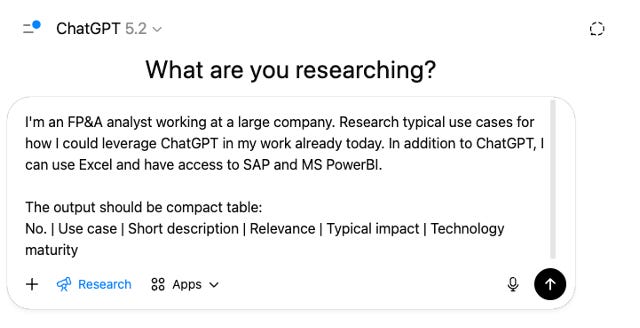
Here’s the prompt in more detail2
**Context**
I’m the Head of FP&A working at a large automotive company. In addition to ChatGPT, I  use MS Office and have access to SAP and Power BI.

**Your task**
1. Understand the typical activities and time sinks in my job.

2. Research practical use cases where ChatGPT can help. Focus only on use cases that already work today. Find examples from practitioners and real-world discussions (e.g., LinkedIn, Reddit, YouTube).

**Output**
Provide a compact table with the top 10 use cases for me:
No | Use case | Short description | Relevance | Impact | Maturity

- Relevance: Indication how much my work could be addressed (high/medium/low)
- Impact: Typical impact for my role (high/medium/low)
- Maturity: Evaluation how far the use case already works really well today (proven/mature/emerging/experimental), including a short explanation
- Sort the table by maturity (proven -> experimental)
- Produce the final output immediately. No explanation before the table.
The more clearly you specify your role, responsibilities, systems, and recurring pain points, the more tailored - and useful - the output of ChatGPT will be. Answer any clarifying questions ChatGPT might still have.
Here is the result of the sample prompt above (excerpt).
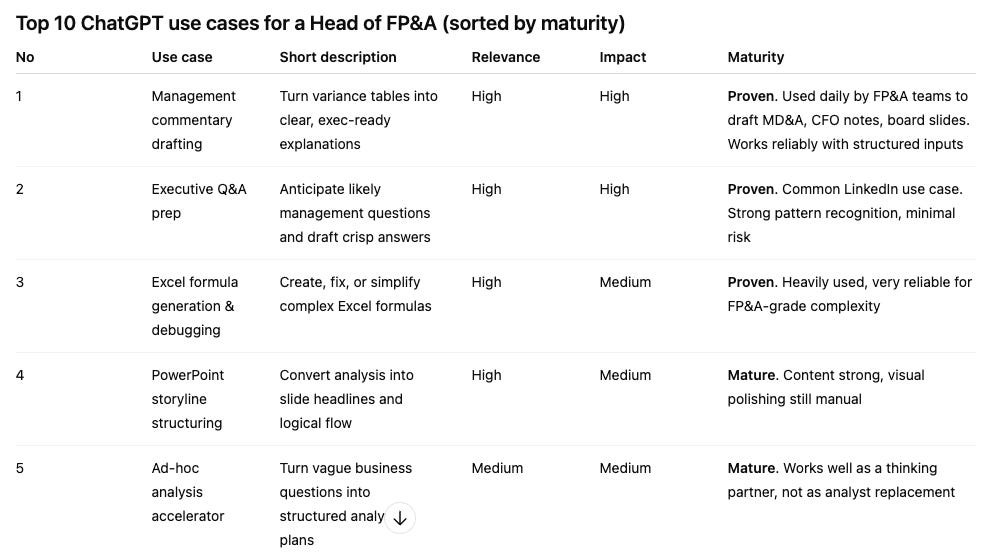
These suggestions are not magical silver bullets. They are use cases that work. I even wonder if those silver bullets really exist. Let me know if you find one.
2. Learn to implement one use case
Next: Pick one use case and learn how to apply it. Again, we just use ChatGPT to help us.
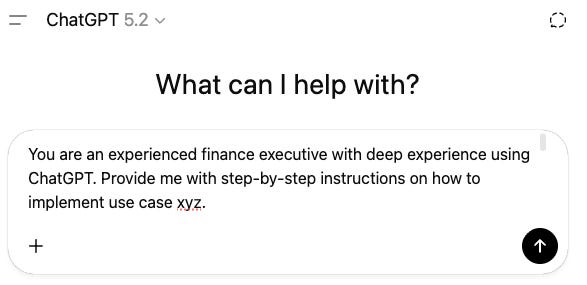
Here’s the prompt a bit more elaborate:
**Your role**
You are an experienced finance executive with deep hands-on experience using ChatGPT.

**Your task**
Explain how to implement the use case "Draft variance and narrative commentary" when I prepare the monthly reporting in order to cut time spend by 30-50%.

Before you answer, ask any clarifying questions you need.

**Output***
- Strengths and potential caveats when using ChatGPT for this task
- Quick checklist before I start
- Step-by-step instructions, including which model to use
- Example prompts and how to refine them
In my personal experience, you should plan for a couple of iterations before you get the use case right and productive.
Practical takeaway: To learn how to leverage ChatGPT in your personal work, use ChatGPT itself, deliberately and with structure. Brief your AI assistant properly to get better results.
What has been your experience so far?
Best,
Sebastian
PS: More on using ChatGPT in finance:
In Copilot this feature is called “Researcher”, in Claude “Research”, in Gemini “Gemini Advanced”.
Ensure you have an enterprise licence before you share personal or confidential information - of course. Otherwise use anonymized examples and placeholders.